

Pharaonic Egypt • Red Sea Voyages • Luxor
Hatshepsut’s Expedition to Punt: The Queen Who Sent Ships Down the Red Sea
Around 3,500 years ago, a female pharaoh sent five ships to a distant “God’s Land” and carved the story on the walls of her temple. Archaeologists on the Red Sea coast near Safaga have now found the harbour where such voyages began.
Short answer: In the ninth year of her reign, Queen Hatshepsut of the Eighteenth Dynasty sent a fleet of five ships down the Red Sea to the Land of Punt, a trading region famous for incense, ebony, ivory and gold. The voyage is recorded in carved reliefs at her mortuary temple at Deir el-Bahri in Luxor. The expeditions of this kind sailed from a harbour now known as Mersa/Wadi Gawasis, on the Red Sea coast about 22 kilometres south of Safaga.
Ruler
Queen Hatshepsut
Expedition
Year 9, Five Ships
Records
Deir el-Bahri Reliefs
Red Sea Port
Saww (Wadi Gawasis)
In This Guide
- The Queen Who Became Pharaoh
- What Was Punt?
- Egypt’s Long Road to Punt
- The Hidden Port: Mersa/Wadi Gawasis
- Building and Launching the Fleet
- The Voyage of Year 9
- Arrival: The King and Queen of Punt
- The Cargo and the Incense Trees
- Carved in Stone at Deir el-Bahri
- Where Was Punt?
- What Archaeology Has Proved
- Seeing This History Today
- Timeline at a Glance
- Frequently Asked Questions
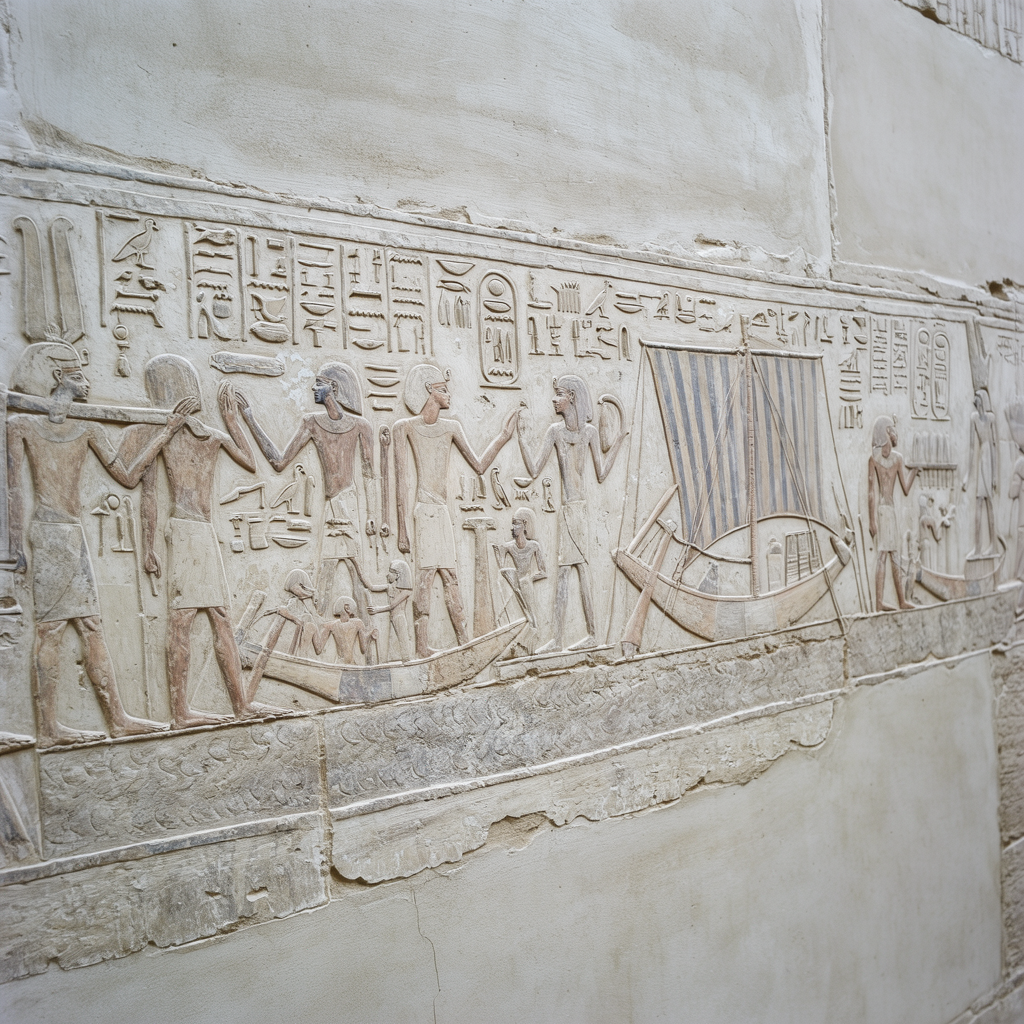
On the west bank of the Nile at Luxor, beneath towering cliffs, stands one of the most graceful buildings of ancient Egypt: the mortuary temple of Queen Hatshepsut at Deir el-Bahri. Among its carved walls is a scene that has fascinated visitors for generations. Ships with billowing sails glide over a sea teeming with fish. Foreign huts on stilts stand among palm and incense trees. A smiling Egyptian official greets a chieftain and his wife. Baskets of living trees are carried up gangplanks.
These carvings describe a real voyage to a land the Egyptians called Punt. For a long time, the reliefs were almost the only evidence of how Egypt reached it. Then archaeologists began digging in the sand near the Red Sea coast, not far from modern Safaga and Hurghada, and found the harbour, the ship timbers and the cargo boxes that bring the story to life.
The Queen Who Became Pharaoh
Hatshepsut belonged to Egypt’s Eighteenth Dynasty, the great line of New Kingdom rulers that included Thutmose III, Amenhotep III and later Tutankhamun. She began as the royal wife of her half-brother Thutmose II and then took on the role of pharaoh herself, ruling for about two decades in the fifteenth century BC. Her reliefs show her in traditional kingly dress, because the idea of a female king was unusual and she wanted to present her authority in the familiar language of Egyptian rule.
Hatshepsut is remembered above all as a builder and a promoter of trade rather than a conqueror. Her reign is associated with monumental building at Karnak and Deir el-Bahri, and with peaceful expeditions that brought wealth into Egypt. The voyage to Punt became the proudest achievement she recorded.
The god’s command. According to the temple texts, the expedition was ordered by the god Amun. In the inscription, Amun tells Hatshepsut that he will give her Punt “the whole of it” and promises that her soldiers will load their ships with fresh incense trees and all the good things of the land. Presenting the voyage as a divine mission made it a religious triumph as well as a commercial one.
What Was Punt?
Punt was a kingdom, or a group of communities, known to the Egyptians from trade records over many centuries. It produced and exported gold, aromatic resins, blackwood, ebony, ivory and wild animals. The Egyptians sometimes called it Ta netjer, meaning “God’s Land,” a phrase linked to the east, the direction of the rising sun, and to the fragrant resins used in temple ritual.
Why Incense Mattered
Frankincense and myrrh were not luxuries for their own sake. Egyptian temples burned incense in daily rituals, and aromatic resins were used in religious ceremonies, perfumes and embalming. Egypt did not have these trees growing locally in useful quantities, so securing a reliable supply meant sending ships beyond its borders. For a pharaoh who wanted to honour Amun, the incense of Punt was spiritually and politically valuable.
Egypt’s Long Road to Punt
Hatshepsut was not the first to reach Punt. Egyptian records show that contact stretched back many centuries before her. The earliest recorded expedition was organised by Pharaoh Sahure of the Fifth Dynasty, around the twenty-fifth century BC, and gold from Punt is mentioned as early as the time of Khufu. Expeditions followed in the Sixth, Eleventh, Twelfth and Eighteenth Dynasties.
- Old Kingdom: Sahure’s voyage returned with valuable goods and people from Punt.
- Eleventh Dynasty: An official named Hannu organised voyages under Mentuhotep III.
- Twelfth Dynasty: Trading missions are recorded under Senusret I, Amenemhat II and Amenemhat IV, and Punt features in a famous literary work, The Tale of the Shipwrecked Sailor.
- Eighteenth Dynasty: Hatshepsut’s expedition is the best illustrated, and her successors Thutmose III and Amenhotep III continued the trade.
What makes Hatshepsut’s expedition special is not that it was the first, but that it was so well documented. The images on her temple walls show the fleet, the people, the plants and the animals in remarkable detail.
The Hidden Port: Mersa/Wadi Gawasis
For many years, scholars knew a great deal about the destination of these voyages but very little about where they started. The answer was found on the Red Sea coast of the Eastern Desert. In the 1970s, the Egyptian archaeologist Abdel Monem Sayed identified the remains of a Middle Kingdom port, known anciently as Saww, at Mersa/Wadi Gawasis, about 22 kilometres south of Safaga. He found inscriptions of the Twelfth Dynasty, including a shrine of an official under Senusret I and a stela of the vizier Intef-iker.
A joint expedition by the University of Naples “L’Orientale” and Boston University, directed by Rodolfo Fattovich and Kathryn Bard, re-examined the site from 2001, and Bard and Fattovich have co-directed excavations there since 2003. What they found changed the field.
Caves Full of Ship Parts
The team discovered man-made caves cut into the fossil coral terrace beside the harbour. Inside were the remains of seagoing ships: timbers, planks, coils of rope and many other nautical items. The caves had been used to store ship parts and equipment between voyages. A stela carved at the site records two royal sailing expeditions, one to Punt and one to Bia-Punt, and mentions two brothers named Nebsu and Amenhotep who made the journey.
The Wonderful Things of Punt
Among the most evocative finds were wooden cargo boxes, some marked with the name of Punt. Researchers have linked the site to the phrase “the wonderful things of Punt.” Excavators also reported cedar planks associated with Hatshepsut’s time, which helped tie the harbour to her expedition. Further evidence includes limestone anchors and anchor blanks, including twenty-six recorded at the site, with white limestone obtained from a quarry about ten kilometres away.
Texts and pottery suggest that Mersa/Wadi Gawasis supported expeditions to Punt for about five hundred years. It was a long-lived gateway, not a one-off harbour.
A discovery near Hurghada. Safaga lies south of Hurghada on the same coast. When you drive along this shoreline, you are passing close to a place where Egyptian ships were assembled for voyages to the “God’s Land.”
Building and Launching the Fleet
How do you send ships to sea from a harbour in the middle of the desert coast, far from the Nile? The evidence from Gawasis gives a striking answer. The Intef-iker stela describes how ships were built at Coptos on the Nile, then taken apart, carried through the wadi routes of the Eastern Desert and reassembled at the Red Sea. It records that thousands of men took part in the effort; figures of over 3,000 men are cited by scholars, with one reading giving over 3,700.
This was a major logistical operation, involving carpenters, sailors, soldiers, labourers and officials. It shows that the Egyptians treated the Red Sea expeditions as state projects requiring planning on a large scale. Many of the same desert routes were later used by the Romans for their own ports and quarries, a story we explore in our guides to the Roman quarries of the Eastern Desert and the ancient Red Sea ports of Berenike and Myos Hormos.
What the Reliefs Show About the Ships
The Deir el-Bahri reliefs depict five ships with details of sails, rigging and crews. Researchers have studied the carvings carefully and concluded that they show a functional rigging plan, a point that helped nautical archaeologists reconstruct how these vessels may have worked. A full-scale replica of an Egyptian seagoing ship was built and sailed on the Red Sea, a project documented in the NOVA film Building Pharaoh’s Ship.
The Voyage of Year 9
The reliefs date the expedition to year 9 of Hatshepsut’s reign. The head of the mission was Chancellor Nehsi, and the temple texts present him as travelling to Punt to collect tribute from the people there. Historians read this as royal propaganda: in practice the expedition was a trading mission to a land that was already an established trading partner. Nehsi did not go alone. He was accompanied by Egyptian soldiers on at least five shiploads, and the party was received warmly.
From the port, the fleet sailed south along the Red Sea, a voyage of roughly 1,200 kilometres according to estimates from the Gawasis site. The Red Sea is not an easy sea for sailors: its coasts are lined with reefs, and ships needed experienced crews. The reliefs show the sea filled with fish, a charming detail that modern divers can appreciate, as the carvers captured species still found in the Red Sea today.
Arrival: The King and Queen of Punt
The most famous scenes show the Egyptians landing and meeting the rulers of Punt. According to the temple reliefs, the land was ruled at that time by King Parahu and Queen Ati. The artists portrayed them with their attendants, carefully recording clothing, hairstyles and goatee beards. The queen’s unusual physique has been discussed by modern commentators, though interpretations vary.
The scenes also show the landscape of Punt: round huts raised on stilts, reached by ladders, standing among palm and incense trees, with cattle and wild animals nearby. The Puntites traded not only their own products, including incense, ebony and short-horned cattle, but also goods from other African regions such as gold, ivory and animal skins. The Egyptians offered goods in exchange, and the relief shows a friendly meeting rather than a conquest.
The Cargo and the Incense Trees
The ships returned heavily loaded. The reliefs and accompanying texts list the wealth that came back to Egypt.
Incense and Resins
Fresh incense trees and aromatic resins, the heart of the mission, intended for the temples of Amun.
Precious Materials
Gold, ebony, ivory and fragrant woods, along with eye cosmetics, and other items listed in the inscriptions.
Animals and Skins
Animal skins and live animals, including baboons, as well as depictions of giraffes, hippopotamuses and leopards in the reliefs.
Living Trees on Board
One of the most remarkable details is the transport of living incense trees. The reliefs show Egyptian sailors carrying trees in baskets or containers up to the ships, evidence that the Egyptians hoped to grow the trees at home. It was an ambitious experiment in plant transplantation, designed to secure incense without having to sail for it every time. The temple presents these trees as a gift for Amun.
In 2018, Polish archaeologists who have worked at the temple since 1961 identified a depiction of a secretary bird in the Portico of Punt, the only known image of this bird in ancient Egypt. Details like this show how closely the artists observed the exotic wildlife of the voyage.
Carved in Stone at Deir el-Bahri
When the fleet returned, Hatshepsut ensured that the achievement was preserved. The story is carved in the Portico of Punt at her mortuary temple, where the scenes appear in sequence: the departure of the fleet, the arrival in Punt, the exchange of goods, the loading of ships and the triumphant return and presentation of goods to Amun and the queen.
The scenes served several purposes at once. They glorified the queen, showed her piety and legitimised her rule by presenting a successful venture blessed by the gods. They also recorded an economic achievement. Because the temple was a place of ongoing worship after her death, the reliefs were meant to be seen and remembered for eternity.
History and propaganda together. The reliefs are both genuine historical evidence and carefully crafted royal messaging. The discoveries at Wadi Gawasis show that the voyages themselves were real, while the temple presentation shapes how the story was told.
Where Was Punt?
The exact location of Punt is still debated. Suggestions have ranged from northeast Sudan and Eritrea to northeast Ethiopia, Djibouti and northern Somalia, and some scholars have argued for southern Arabia. A majority of scholars now place Punt in East Africa, in the Horn of Africa region, largely because the products and animals shown in the reliefs, including gold, myrrh, frankincense, ebony, giraffes, baboons, hippopotamuses and leopards, are abundant there and less common in Arabia.
Clues from Baboons
Some of the most intriguing evidence comes from mummified baboons. In 2010, researchers analysing hair from two mummified baboons found chemical signatures that matched modern baboons from Eritrea and eastern Ethiopia, not Somalia or Yemen. A later study in 2020 found that mummified baboons from Egyptian sites were hamadryas baboons born outside Egypt, in an area spanning present-day Eritrea, Ethiopia and northwestern Somalia, and a DNA study published in 2023 pointed to Eritrea. These results are suggestive rather than final, and some researchers still argue for other locations. What is clear is that Punt lay far to the south along the Red Sea route.
The modern Somali region of Puntland takes its name from the ancient kingdom.
What Archaeology Has Proved
For decades, some scholars wondered whether the Deir el-Bahri reliefs were mostly propaganda and whether Egyptians really sailed the Red Sea in their own ships. Wadi Gawasis answered that. Excavations there provided the first direct evidence of Egyptian seafaring in Egyptian ships: ship timbers, ropes, anchors, cargo boxes and inscriptions that confirm that the voyages were real and well organised.
The finds also reveal how the system worked. Ships were built on the Nile, transported in pieces across the desert, reassembled, repaired, stored and launched, and cargoes were returned the same way. A later text, Papyrus Harris I from the reign of Ramesses III, describes an expedition returning to Egypt: goods were unloaded at the desert coast, carried overland on donkeys and men to Coptos, and then sent downstream on the Nile in festivity. It shows that the routes established by earlier pharaohs remained in use for centuries.
Punt trade continued under Hatshepsut’s successors and into the early Twentieth Dynasty, then ended before the close of the New Kingdom. After that, Punt became a semi-legendary place in Egyptian memory, remembered in songs and stories as a land of perfume and delight.
Seeing This History Today
You can connect with this story in several places.
- Deir el-Bahri, Luxor: The mortuary temple of Hatshepsut on the west bank is the best place to see the Punt reliefs in person. It is one of the major sites visited on Luxor day trips from the Red Sea coast.
- Mersa/Wadi Gawasis, near Safaga: The harbour site is an active archaeological area in the desert, not a standard tourist attraction, and access depends on permissions and conditions.
- The Red Sea itself: Snorkelling or sailing off the coast gives you a feel for the waters and reefs that Egyptian sailors had to navigate.
If you are staying in Hurghada, a day trip to Luxor can bring Hatshepsut’s story to life on the spot. Whether a particular itinerary includes her temple depends on the programme, so please ask our team at HurghadaToGo when you enquire.
Timeline at a Glance
25th century BC
Pharaoh Sahure sends the earliest recorded Egyptian expedition to Punt.
Around 2000 BC
Officer Hannu organises voyages under Mentuhotep III.
Twelfth Dynasty
Expeditions under Senusret I, Amenemhat II and Amenemhat IV sail from the harbour of Saww at Wadi Gawasis.
15th century BC, Year 9
Hatshepsut sends a five-ship expedition to Punt under Chancellor Nehsi.
After Hatshepsut
Thutmose III and Amenhotep III continue trade with Punt.
Early Twentieth Dynasty
Papyrus Harris I records an expedition returning from Punt; the trade then ends before the New Kingdom closes.
1970s
Abdel Monem Sayed identifies Mersa/Wadi Gawasis as the ancient port of Saww.
2001 onwards
Italian-American excavations at Wadi Gawasis uncover ship timbers, caves, anchors and cargo boxes.
Frequently Asked Questions About Hatshepsut and Punt
Who was Hatshepsut?
Hatshepsut was a pharaoh of Egypt’s Eighteenth Dynasty who ruled in the fifteenth century BC. She is famous for her building projects and for the expedition to Punt recorded at her temple.
What was the Land of Punt?
Punt was a trading region known from Egyptian records that supplied gold, incense resins, ebony, ivory and wild animals. The Egyptians sometimes called it God’s Land.
When did Hatshepsut’s expedition take place?
The reliefs date it to year 9 of her reign. It is usually placed in the fifteenth century BC.
How many ships were in the fleet?
The Deir el-Bahri reliefs show five ships.
Who led the expedition?
The temple texts name Chancellor Nehsi as head of the expedition.
Where did the ships sail from?
Expeditions of this kind sailed from the harbour of Saww, now Mersa/Wadi Gawasis, on the Red Sea coast about 22 kilometres south of Safaga.
What did the ships bring back?
Incense trees and resins, ebony, ivory, gold, fragrant woods, cosmetics, animal skins and live animals, according to the reliefs and texts.
Where was Punt located?
Its exact location is debated, but most scholars place it in the Horn of Africa region, with some evidence pointing to Eritrea and eastern Ethiopia.
What did archaeologists find at Wadi Gawasis?
They found ship timbers, ropes, anchors, cargo boxes, caves used to store ship parts and inscribed stelae confirming royal expeditions to Punt.
Where can I see the Punt reliefs?
At Hatshepsut’s mortuary temple at Deir el-Bahri on the west bank of the Nile at Luxor.
Can I visit Luxor from Hurghada?
Luxor excursions run from the Red Sea coast, and our team can explain current options and what each itinerary includes.
A Voyage That Still Speaks
Hatshepsut’s expedition to Punt is more than a beautiful set of carvings. It is a window into how ancient Egyptians organised ships, labour and diplomacy to reach distant lands, and it connects the temples of Luxor with the shores of the Red Sea. The harbour at Wadi Gawasis, the ship timbers in the desert caves and the reliefs at Deir el-Bahri tell one story from different angles.
If you are in Hurghada, you are standing on the same coast. Behind you are the desert routes that carried ships in pieces to the sea, and ahead lies the water along which Egypt’s first great sea voyagers sailed in search of the God’s Land.
Explore Egypt’s Story with HurghadaToGo
Interested in Luxor, Red Sea history or day trips from Hurghada? Tell us your dates and interests and we will help you plan.
WhatsApp +201009255585 [email protected]
Explore more at Hurghada Excursion and HurghadaToGo
Historical references
Background drawn from publicly available scholarship and reference pages, including Land of Punt on Wikipedia, Boston University’s reports on Mersa/Wadi Gawasis, Kathryn Bard and Rodolfo Fattovich’s excavation summaries, and Cheryl Ward’s study of Egyptian seafaring ships in the Journal of Ancient Egyptian Interconnections.