

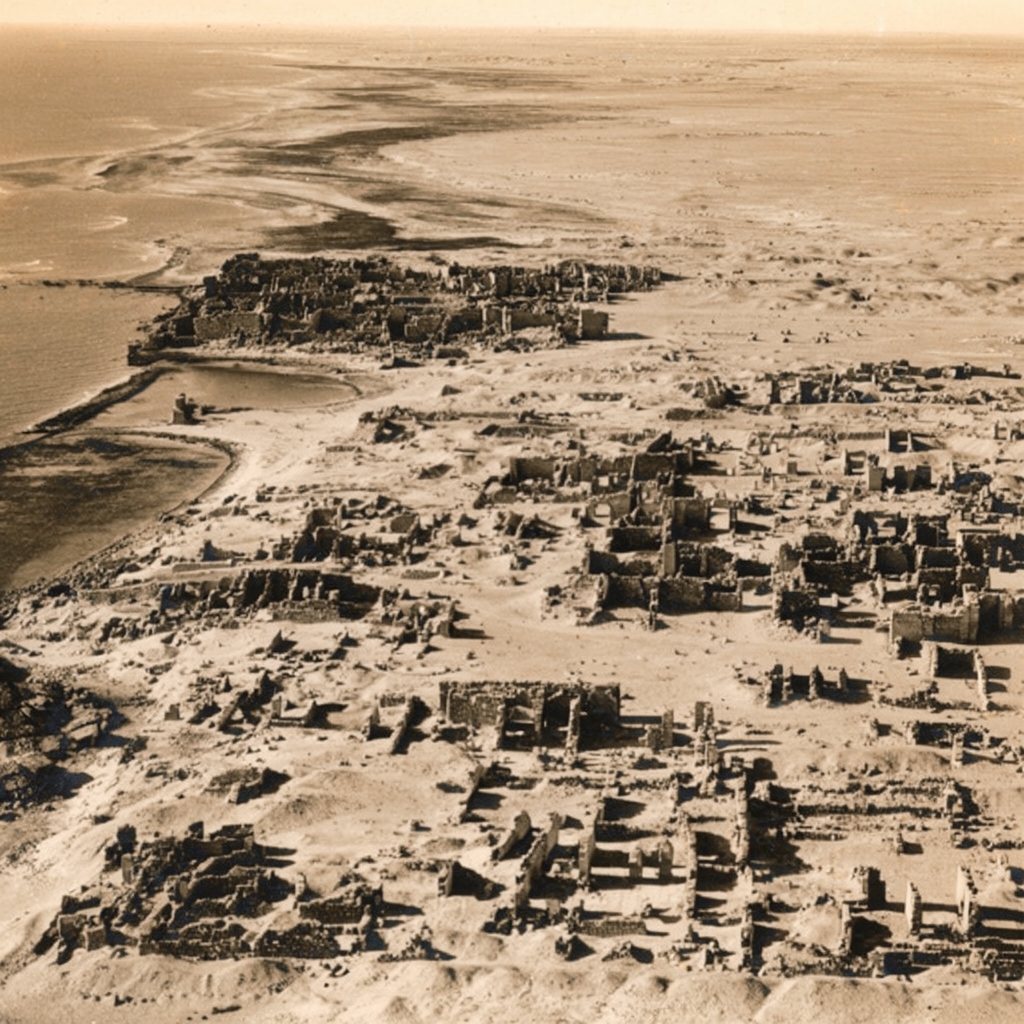
Ancient Red Sea • Roman Egypt • Indian Ocean Trade
Berenike and Myos Hormos: The Ancient Red Sea Ports That Linked Rome to India
Long before modern resorts lined the Red Sea coast, two harbours in the Egyptian desert sent ships across the monsoon to India and brought back pepper, pearls and ivory for the Roman world. This is their true story.
Short answer: Berenike and Myos Hormos were the two great Egyptian Red Sea ports of the Ptolemaic and Roman eras. Goods from the Mediterranean and the Nile Valley were carried across the Eastern Desert to these harbours, loaded onto ships, and sent across the Arabian Sea to India using the seasonal monsoon winds. Berenike lies on the southern Egyptian coast near Ras Banas, while Myos Hormos is identified with Quseir al-Qadim, close to the modern town of Quseir.
Berenike Founded
Under Ptolemy II
Berenike Active
About 800 Years
Trade Guidebook
The Periplus (1st c. AD)
Key Indian Port
Muziris, Kerala
In This Guide
- Before Rome: The Ptolemies and the Red Sea
- The Monsoon Secret and the Periplus
- Berenike: The Southern Gateway
- Myos Hormos: The Port of Quseir al-Qadim
- Desert Roads from the Nile
- What Went East and What Came West
- The Indian End: Muziris and Beyond
- The Muziris Papyrus: A Cargo on Paper
- People, Gods and Cultures
- Decline and Rediscovery
- The Ports and the Red Sea Today
- Timeline at a Glance
- Frequently Asked Questions
Many people have heard of the Silk Road, the overland network that carried goods across Asia. Fewer know that the ancient world had another great trade artery, one that ran by sea. During the heyday of the Roman Empire, merchant ships left Egypt’s Red Sea coast, crossed the Indian Ocean, and returned loaded with the luxuries of the East. The ports that made this possible have been excavated only in recent decades, and what archaeologists have found is astonishing.
For anyone who loves the Red Sea, the story has a special appeal. The same waters that divers and snorkellers enjoy today once carried ships bound for India. The coast between Hurghada and the far south was part of a trade network linking Europe, Africa and Asia, and its remains lie quietly in the desert, waiting to be understood.
Before Rome: The Ptolemies and the Red Sea
The story begins before the Romans took control of Egypt. After Alexander the Great, Egypt was ruled by the Greek-speaking Ptolemaic dynasty, whose kings looked outward to the Red Sea for resources. One of their needs was war elephants. The Ptolemies wanted African elephants for their armies, and they needed a way to bring them north from the regions south of Egypt.
Berenike was founded under Ptolemy II, who ruled from 285 to 246 BC. According to the archaeologists who have worked there, it was established to obtain African elephants and to import aromatics and other commodities. The Ptolemies built forts, wells and roads in the desert to support the operation. In other words, the infrastructure that Rome later used for its India trade was already in place.
Not only Berenike and Myos Hormos. Other harbours were used earlier or alongside them, including Arsinoe near today’s Suez. But Berenike and Myos Hormos, more easily reached from the Nile and better placed for sailing south, soon overshadowed the older ports.
The Monsoon Secret and the Periplus
The great breakthrough in the India trade was understanding the monsoon winds. In the Arabian Sea, the winds blow from the southwest in summer and from the northeast in winter. Sailors who timed their voyages to these seasonal patterns could cross the open sea in weeks rather than hugging the coast for months. A ship could ride the southwest monsoon towards India, wait for the season to change, and return on the northeast monsoon. Ancient tradition credits a Greek navigator named Hippalus with revealing the secret, though historians debate how the knowledge actually spread.
A Merchant’s Handbook
The best surviving guide to this world is the Periplus of the Erythraean Sea, a practical handbook written in Greek around the middle of the first century AD, usually dated to about AD 40–55. Its author was an anonymous, Greek-speaking Egyptian merchant. The text lists ports, describes anchorages, mentions the goods bought and sold in each place, and even notes the months in which ships should sail. The “Erythraean Sea” was the ancient name for the waters including the Red Sea, the Gulf of Aden and the Arabian Sea.
The Periplus begins with the Egyptian harbours. It names Myos Hormos, often translated as “Mussel Harbour,” and Berenike as the first of the official trading ports on the Red Sea. Scholars note that they were “designated” ports, meaning that trade was channelled through them, which made it easier for the Roman state to supervise and tax.
Berenike: The Southern Gateway
Berenike (sometimes written Berenice, or Berenice Troglodytica) lies on the Red Sea coast about 260 kilometres east of Aswan, near the peninsula of Ras Banas. The site was identified in the early nineteenth century by the explorer Giovanni Belzoni, who recognised the ruins as the ancient port. Its position was ideal: it had natural harbours sheltered from the prevailing northern winds, and Ras Banas served as a landmark for ships.
Eight Centuries of Trade
Berenike operated for roughly 800 years, from the Ptolemaic period into the sixth century AD. It was especially active from the first century BC to the second century AD, when it was one of the main shipping centres linking the Mediterranean, Arabia and India. By the seventh century it had been abandoned.
What Excavations Found
Modern excavations began in 1994 under the archaeologist Steven Sidebotham of the University of Delaware, later continuing with the Polish Centre of Mediterranean Archaeology at the University of Warsaw. The results have reshaped our understanding of the Indian Ocean world. Thousands of objects and organic remains show that Berenike was connected to regions as far west as the Iberian Peninsula and north-west Africa and as far east as the island of Java.
The strongest links, however, were with India. Among the finds are several Indian objects of exceptional interest: a terracotta soldier, three small stone Buddha statuettes, a carved stele with figures known as Vrishni heroes, and a dedicatory inscription in Sanskrit and Greek dated to the sixth regnal year of the Roman emperor Philip the Arab, which corresponds to AD 248. Researchers also study the remains of ships that brought Indian merchants to the port. These objects suggest that Indians were not only trading partners but present at Berenike itself.
Why this matters: A Buddha statuette in an Egyptian desert port is a vivid reminder that the Red Sea was a place of cultural exchange, not just commerce. Religion, art and ideas travelled alongside the cargo.
Myos Hormos: The Port of Quseir al-Qadim
Myos Hormos was Berenike’s northern partner. For a long time, scholars argued about exactly where it stood. Ancient geographical coordinates seemed to point to the area of Abu Sha’ar north of Hurghada, while the descriptions in ancient texts and the course of the desert road pointed to Quseir al-Qadim, a site on the coast near the modern town of Quseir.
Solving the Puzzle
Excavations at Quseir al-Qadim by the University of Chicago in the late 1970s and 1980s, and later by the University of Southampton between 1999 and 2003 led by David Peacock and Lucy Blue, settled the question for most researchers. A papyrus loan agreement referring to a transaction “here at Myos Hormos” and other written evidence confirmed the identification. Further papyrus letters from the second century AD mention Myos Hormos as a place on the coast at the end of the road, which fits Quseir.
Excavators have found remains of harbour structures, including sea walls, as well as a wealth of everyday material. Plant remains include pepper, one of the key imported spices, and the finds from the site tie it firmly to the Indian trade. Quseir al-Qadim was later reused as an Islamic-period port, and the excavations record both phases.
Like Berenike, Myos Hormos was founded for trade. It had no rich farmland behind it; it existed to receive caravans, load ships and unload cargoes.
Desert Roads from the Nile
The ports could not work without the roads. Cargoes moved up and down the Nile, then crossed the Eastern Desert to the coast. The town of Coptos (modern Qift, near Qena) on the Nile was the great starting point. Ancient writers including Strabo and Pliny the Elder describe the journey from Coptos across the desert at length.
The Romans fortified these routes. A road led from Coptos to Myos Hormos, with forts and wells at intervals, and archaeologists excavating at el-Zerqa, roughly halfway along the road, found written ostraca that helped identify the port at the end. Another road ran to Berenike. These are the same Eastern Desert routes that also served the imperial quarries of Mons Porphyrites and Mons Claudianus, which means the desert behind Hurghada was crisscrossed by a network of Roman roads, forts and way-stations.
A Journey in Stages
- Alexandria and the Mediterranean: Goods arrived from across the Roman world.
- The Nile: Cargoes were shipped upriver to Coptos.
- The desert road: Caravans of animals moved goods across the Eastern Desert, stopping at fortified stations.
- The Red Sea port: Cargoes were stored, taxed and loaded onto seagoing ships.
- The ocean crossing: Ships followed the monsoon to India and back.
What Went East and What Came West
Trade moved in both directions, and the mixture of goods tells us how the economies of the Roman world and India fitted together.
Going East
Wine, olive oil, glassware, fine metalwork and coins, trans-shipped at the Egyptian ports into Red Sea craft. The Periplus particularly mentions wine and olive oil carried in pottery amphorae.
Coming West
Black pepper above all, plus pearls, ivory, gemstones, spikenard, tortoiseshell, timber and textiles, with silk reaching Rome through Indian ports.
From Africa and Arabia
The Periplus also describes Red Sea and East African markets that supplied aromatics, ivory and other products to the same network.
The pepper deserves special mention. Black pepper was the great Indian spice of the age, and finds from Red Sea ports show it arriving in quantity. At Berenike, archaeologists have recovered pepper and other South Asian plant remains, a direct link to the cargoes described in ancient texts.
The Indian End: Muziris and Beyond
On the other side of the ocean, the Periplus links the Egyptian harbours to several Indian ports. Three stand out: Muziris on the Malabar Coast in what is now Kerala, Nelkunda, and Barygaza further north. Muziris was the great pepper port, and the Roman writer Pliny the Elder called it the first trading centre of India.
Muziris was the main trading port for the Chera chiefdom, and its exports included black pepper, malabathron (a fragrant leaf), beryl, pearls, ivory, spikenard and tortoiseshell. Its precise location has long been discussed, and the excavations at Pattanam in Kerala are widely connected with the ancient port, though scholars continue to debate the identification.
Roman coins found in India and Indian objects found in Egypt make the same point from both ends: this was a genuine two-way exchange, not a one-sided flow of goods.
The Muziris Papyrus: A Cargo on Paper
One of the most extraordinary documents of the ancient economy is the Muziris papyrus, a fragmentary Greek text from the middle of the second century AD, now in Vienna. It carries two related documents. One side is a loan agreement financing a trading voyage to South India. The other is an assessment of the value of an Indian cargo brought back on a ship named the Hermapollon, prepared for the purpose of calculating customs duty.
The papyrus describes a deal involving an Alexandrian merchant and a financier. It shows how voyages were funded, how risk was shared, and how the Roman state collected a share of the profits. The cargo included large quantities of pepper, as well as other Indian goods, and the value recorded for the portion preserved is often estimated at around nine million sesterces, a vast sum. Part of the cargo was probably taken as a quarter-tax in kind.
How big was the trade? Pliny the Elder complained that Rome lost huge sums of money to India every year, giving figures of around fifty million sesterces. Strabo reportedly said that as many as 120 ships a year left the Red Sea ports. Modern scholars treat these numbers with caution and debate how typical a single ship like the Hermapollon was, but all agree the trade was substantial.
People, Gods and Cultures
These were not sleepy outposts. Archaeological and written evidence show cosmopolitan communities. Greek-speaking Egyptians, Roman officials and soldiers, desert nomads, sailors from Arabia and the Indian coasts, and Indian merchants all passed through. Letters and ostraca record debts, shipments and everyday concerns, giving the ports a human voice.
Ships and Sailors
The ships themselves have left traces. Timbers and fittings found at the ports show where vessels were built or repaired, and the study of wooden remains has helped researchers learn which woods were imported, some of them from India. Researchers working at Berenike have specifically examined remains of ships that carried Indian merchants to Egypt, a direct reminder that the voyages ran in both directions.
Faith Across the Sea
Religion travelled too. The Sanskrit and Greek inscription and the Buddha statuettes from Berenike show Indian religious life present on the Egyptian coast. At the same time, Egyptian, Greek and Roman gods were worshipped at the desert stations. Sailors of every background had good reason to pray for safe voyages.
Decline and Rediscovery
The Red Sea trade rose and fell with the wider economy of the ancient world. The busiest period was around the first and second centuries AD. In later centuries, political change, shifting trade routes and changes in the harbours themselves reduced the importance of the old ports. Berenike held on until the sixth century AD but had been abandoned by the seventh. Quseir al-Qadim continued as a port in the Islamic era before eventually being left behind.
For centuries, the ports were forgotten. Berenike was identified by Belzoni in 1818, but it was only in recent decades that large-scale excavations transformed the picture. Sidebotham’s work from 1994 and the Southampton project at Quseir al-Qadim brought to light thousands of artefacts, texts and plant remains. Researchers continue to work at Berenike, and new discoveries are still being published.
The modern study of these ports has also changed how historians think about globalisation. The idea that the ancient world was divided into isolated empires is hard to maintain when a single desert harbour yields goods and objects from Spain to Java.
The Ports and the Red Sea Today
Modern travellers in Hurghada are sailing the same sea. The coast south of Hurghada leads towards Quseir and the far south, where ancient harbour sites lie in remote desert terrain. Quseir al-Qadim is an archaeological site near the modern town of Quseir, and Berenike is far to the south on the coast near Ras Banas.
Practical Points
- Remote locations: Berenike in particular is in a remote area, and access to archaeological sites can depend on permissions and current regulations.
- Use licensed operators: Check current rules and conditions with a licensed operator before planning any trip to desert or archaeological sites.
- Respect the sites: Do not move, remove or climb on ancient remains.
- Combine your interests: History lovers can pair this story with the temples of Luxor and the Red Sea’s sea-based adventures.
We cannot promise that an excursion to these particular sites is available on any given date. If you would like to explore Red Sea history during your stay, contact our team at HurghadaToGo and we will tell you what is currently possible, or recommend alternative history-focused trips from Hurghada.
Timeline at a Glance
285–246 BC
Reign of Ptolemy II, under whom Berenike is founded to obtain elephants and aromatics.
1st century BC
Red Sea trade expands under Roman influence, with Berenike and Myos Hormos central to it.
About AD 40–55
The Periplus of the Erythraean Sea is written by an anonymous Greek-speaking Egyptian merchant.
Mid-2nd century AD
The Muziris papyrus records a loan and the valuation of the Hermapollon’s Indian cargo.
AD 248
A Sanskrit and Greek inscription is dated to the sixth year of Philip the Arab, found at Berenike.
6th–7th century AD
Berenike declines and is abandoned by the seventh century.
1818
Belzoni identifies the ruins of Berenike near Ras Banas.
1994 onwards
Modern excavations at Berenike begin; Southampton’s work at Quseir al-Qadim (1999–2003) confirms Myos Hormos.
Frequently Asked Questions About Berenike and Myos Hormos
What was Berenike?
Berenike was a Ptolemaic and Roman port on Egypt’s Red Sea coast, active for roughly 800 years, which served as a major link between the Mediterranean world and the Indian Ocean.
What was Myos Hormos?
It was the other great Egyptian Red Sea port of the period, identified with Quseir al-Qadim near the modern town of Quseir, at the end of the desert road from Coptos on the Nile.
Why was Berenike founded?
According to its excavators, it was established under Ptolemy II to obtain African elephants for the Ptolemaic army and to import aromatics and other goods.
How did ships get to India?
They used the seasonal monsoon winds, sailing from the Red Sea across the Arabian Sea with the southwest monsoon and returning with the northeast monsoon.
What is the Periplus of the Erythraean Sea?
It is a first-century AD Greek merchant’s handbook describing ports, routes, sailing seasons and trade goods from Egypt to East Africa, Arabia and India.
What did Rome buy from India?
Above all black pepper, along with pearls, ivory, gemstones, spikenard, tortoiseshell, textiles and other luxuries.
What did Rome send east?
Wine, olive oil, glassware, metalwork and coins, among other goods.
What is the Muziris papyrus?
It is a second-century AD Greek papyrus recording a loan for a voyage to South India and the valuation of the cargo carried by a ship called the Hermapollon.
Were Indians present at Berenike?
Archaeological finds, including Indian statuettes and a Sanskrit and Greek inscription, point to a significant Indian presence and strong cultural links.
When were the ports abandoned?
Berenike declined in late antiquity and was abandoned by the seventh century AD, while Quseir al-Qadim was later reused in the Islamic period.
Can I visit these sites from Hurghada?
Access depends on location, permissions and current rules. Contact our team and we will tell you what is possible.
The Red Sea as a Highway of the Ancient World
Berenike and Myos Hormos show that the Red Sea was never a barrier. For centuries it was a highway, connecting the Nile Valley with the Indian Ocean and the Roman Mediterranean with the Indian subcontinent. Ships, caravans, sailors, soldiers and merchants of many nations moved through these desert harbours, and their letters, coins, spices and statues survive to tell us how connected the ancient world really was.
Next time you look out over the Red Sea from Hurghada, imagine a cargo ship in the first century AD heading south with the winds, loaded with wine and oil, bound for the pepper ports of Kerala. It is a story as grand as any in Egypt’s long history.
Discover the Red Sea with HurghadaToGo
From history-rich day trips to snorkelling, diving and island days, tell us your dates and interests and we will help you plan your stay.
WhatsApp +201009255585 [email protected]
Explore more at Hurghada Excursion and HurghadaToGo
Historical references
Background drawn from publicly available scholarship and reference pages, including the Berenike excavation lecture abstracts of Steven Sidebotham (Honor Frost Foundation), the Indians in Roman Berenike article, Roman Red Sea port studies by Roberta Tomber and by Whitcomb and Johnson, the Periplus of the Erythraean Sea, and the Muziris and Muziris papyrus scholarship of Federico De Romanis.