

Ancient Egypt • Roman Empire • Eastern Desert
Mons Porphyrites and Mons Claudianus: The Roman Imperial Quarries Behind Hurghada
Deep in the Red Sea mountains, the Roman emperors opened two remote quarries to cut the purple stone of power and the granite columns of the Pantheon. This is the true story of the desert outposts that helped build imperial Rome.
Short answer: Mons Porphyrites (today Gebel Dokhan) and Mons Claudianus were Roman imperial quarries in Egypt’s Eastern Desert. Porphyrites was the only known source of the famous purple “imperial” porphyry reserved for emperors, while Claudianus supplied huge granodiorite columns, including those of the Pantheon portico in Rome. Both lie in the Red Sea Mountains between the Nile at Qena and the Red Sea coast near Hurghada.
Famous Stone
Imperial Purple Porphyry
Discovered
AD 18 (Porphyrites)
Active
1st–5th Century AD
Rome’s Landmark
The Pantheon Columns
In This Guide
- Why Rome Came to the Eastern Desert
- Mons Porphyrites: The Mountain of Purple Stone
- Imperial Porphyry: The Stone of Emperors
- Mons Claudianus: Columns for the Pantheon
- Who Really Worked in the Quarries?
- Daily Life, Food and Faith in the Desert
- Moving Giant Stones to the Nile and Rome
- Abandonment and Rediscovery
- The Legacy of Imperial Porphyry
- Visiting the Quarries Today
- Timeline at a Glance
- Frequently Asked Questions
Most visitors to Hurghada come for the sea. Yet just inland, behind the coastal plain, the Red Sea Mountains hide one of the most remarkable stories of the Roman world. In a landscape of dry riverbeds and rugged peaks, Roman engineers, soldiers and skilled workers built fortified settlements, cut enormous blocks of stone from the mountainsides, and sent them on a journey that ended in the palaces, temples and tombs of emperors.
This was not a small enterprise. The quarries of the Eastern Desert supplied the stone that made imperial Rome look like imperial Rome. Today the sites are quiet, but the ruins, abandoned columns and thousands of written fragments left behind give us a vivid picture of how the Romans organised life and labour at the edge of their empire.
Why Rome Came to the Eastern Desert
When Egypt became a province of the Roman Empire, its stone resources came under imperial control. Marble and coloured stones were far more than building materials. They were a way of showing power. A palace, bath or temple clad in rare stone told every visitor that the emperor commanded the resources of the whole world. Scholars studying the quarries have noted that marble was central to how the empire represented its wealth and power.
Egypt already had a long tradition of working hard stone, from the granite of Aswan to the quarries of the Nile Valley. The Romans built on that knowledge and pushed further into the desert, prospecting the Eastern Desert for new sources. The Eastern Desert, the great belt of mountains between the Nile and the Red Sea, was already crossed by tracks used for mining and trade. Under Roman rule, those tracks were organised into protected routes with forts, wells and way-stations.
Four imperial quarries. Besides Mons Porphyrites and Mons Claudianus, the Eastern Desert also contained the quarries of Mons Ophiates and Tiberiane. Evidence suggests that these sites were probably run under a unified administration, because the same imperial official is recorded at more than one of them.
Mons Porphyrites: The Mountain of Purple Stone
Mons Porphyrites is the Latin name for the mountain known today in Arabic as Gebel Dokhan, often translated as the “Smoking Mountain.” It sits in the Red Sea Hills of the Eastern Desert, and for the Roman world it was the only known source of the deep purple stone called imperial porphyry. The name “porphyry” itself comes from the Greek word for purple.
The Discovery in AD 18
According to the surviving evidence, the quarries were discovered in AD 18 by a Roman named Caius Cominius Leugas. Archaeologists have found an inscription associated with him at the earliest settlement on the site, where there was a small temple to the god Pan. It was the beginning of an operation that lasted for centuries: the quarries were worked from the first century AD until around the 430s, a conclusion drawn from hundreds of inscribed pottery fragments recovered there.
A Quarry Landscape, Not a Single Pit
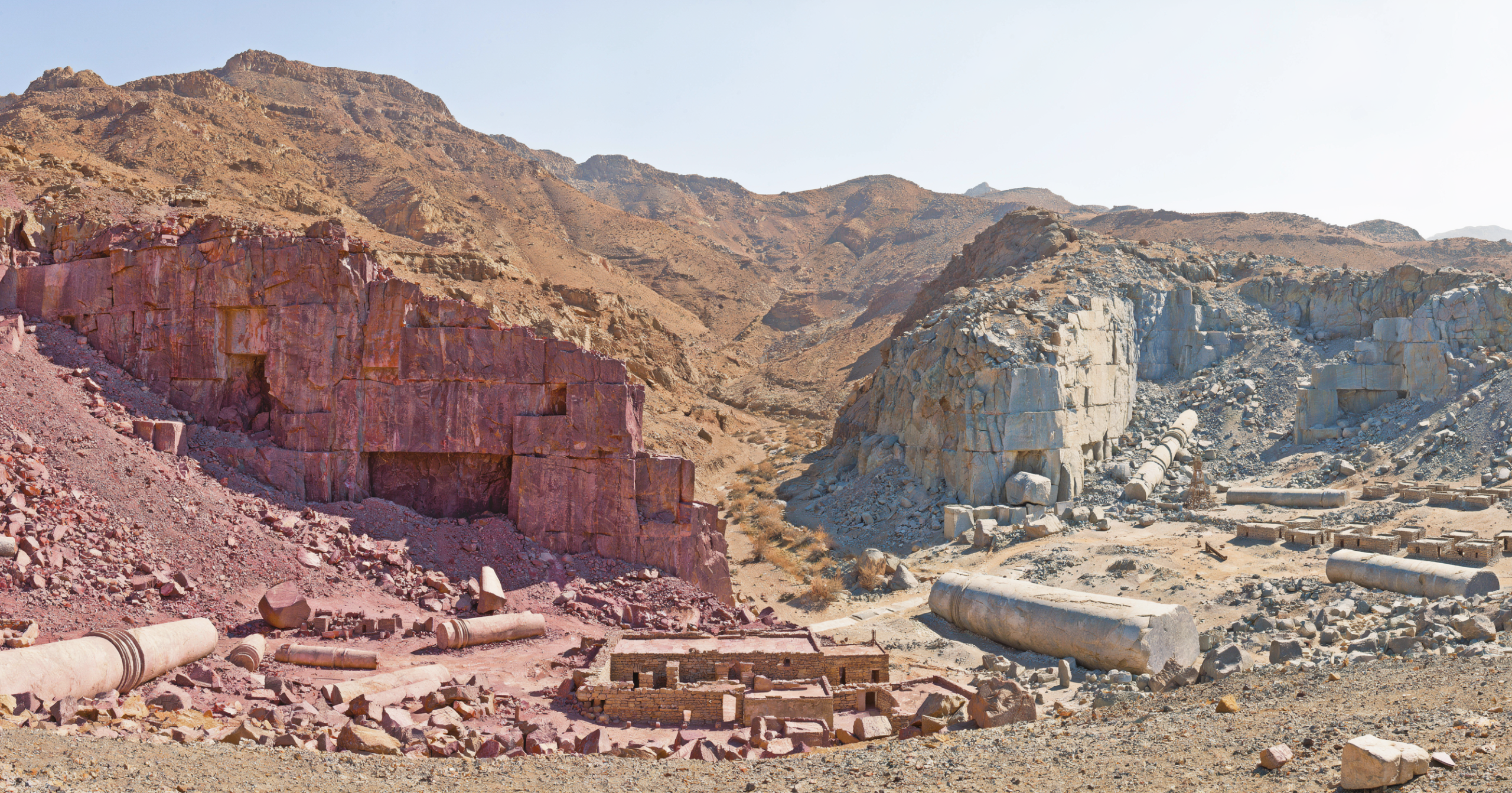
It is easy to imagine a quarry as one big hole in the ground. Porphyrites was nothing like that. The workings were spread across roughly nine square kilometres of mountain terrain. The highest quarries, at a place called Rammius, lay at about 1,438 metres above sea level. Five scattered villages housed the workers, and a central complex stood in the Wadi Abu Ma’amel at about 630 metres.
Because the stone was cut high on the mountain, engineers built slipways — carefully prepared slopes down which the blocks could be lowered to the valley floor. This was the most dangerous part of the job, as every block was heavy and the descent steep.
What the Central Complex Contained
- A fort to guard the site and its supply lines, with a tower that allowed visual signalling to even the most distant posts.
- Wells and a large cistern to store precious water in the desert.
- A workers’ settlement, including evidence of blacksmithing to keep tools in repair.
- A bathhouse with a hypocaust, the Roman underfloor heating system, which shows how seriously the Romans took comfort even here.
- Temples to the Egyptian-Greek god Sarapis and the goddess Isis, dated by inscriptions to the early second century AD.
- A cemetery where members of the community were buried.
Mons Porphyrites also produced black porphyry, not only the purple variety for which it became famous. Smaller fortlets guarded the approaches, and the quarry was reached by a circuitous branch of the road linking the Nile town of Qena (ancient Caene) with a Roman fort on the Red Sea coast, in the area of modern Abu Sha’ar. Along that route stood small forts such as Deir el-Atrash.
Imperial Porphyry: The Stone of Emperors
What made the stone from Porphyrites so special? First, its appearance. Imperial porphyry is a hard, reddish-purple rock speckled with small pale crystals, and it takes a brilliant polish. Second, its rarity: this variety was found nowhere else in the Roman world. Third, its colour. In the ancient Mediterranean, purple was the colour of rulers, and a stone of that colour carried an obvious message.
An Imperial Monopoly
Throughout the Roman period, the stone was effectively an imperial monopoly, used for the emperors’ own projects. Specialists record its use in the interior of Trajan’s Basilica, in the Pantheon and in the Temple of Venus and Rome, all at the heart of the capital. It was also carved into statues, including figures of Dacian captives of the emperor Trajan now in Florence and Paris.
Sarcophagi and the Tetrarchs
In the later empire, porphyry became closely linked to death and dynasty. Massive imperial sarcophagi in the stone survive in Rome and Istanbul. The famous group of four embracing rulers known as the Tetrarchs, carved from porphyry, is now built into the facade of St Mark’s Basilica in Venice. Byzantine tradition also held that Constantine the Great was buried in a porphyry sarcophagus in Constantinople.
“Born in the purple.” The Greek title Porphyrogennetos meant “purple-born.” It was given to Byzantine imperial children born while their father was ruling, and a special chamber in the Great Palace of Constantinople, lined with porphyry, was known as the Porphyra. A stone from the mountains behind the Red Sea coast had become part of the language of royalty.
Mons Claudianus: Columns for the Pantheon
About 50 kilometres from Porphyrites lies the second great imperial site, Mons Claudianus. It sits at an altitude of roughly 700 metres in the heart of the Red Sea Mountains, around 120 kilometres east of the Nile, midway between Qena on the river and the Red Sea coast, in what is today the Red Sea Governorate.
Claudianus was not a source of purple stone. It produced granodiorite, a hard speckled granite-like rock, which Rome used for monumental architecture. It was quarried from around the first century AD until the middle of the third century AD. There is no evidence of settlement at the site before the Romans arrived.
The Giants of the Pantheon
The most famous products of Claudianus are the great monolithic columns of the Pantheon portico in Rome. Each is about 12 metres tall, around 1.5 metres in diameter, and weighs roughly 60 tons. Stone from Claudianus is also associated with Hadrian’s Villa at Tivoli, public baths, the Temple of Venus and Diocletian’s Palace at Split.
A Fortified Settlement
The settlement at Claudianus looked like a fort, with walls and projecting towers, and it is estimated to have housed around 1,000 people, including quarrymen and guards. The complex consisted of a garrison, the quarrying area and quarters for civilians and workers. A survey identified more than one hundred separate quarries on the site, and slipways cut into the mountainside still mark the landscape. Many buildings survive to roof height, and the dry climate preserved written documents and organic remains that would have vanished almost anywhere else.
Who Really Worked in the Quarries?
Popular imagination pictures Roman quarries as places of misery, worked by convicts, enslaved prisoners or persecuted Christians. Researchers who have studied the evidence from Porphyrites and Claudianus describe a very different picture. Inscribed potsherds, honorary monuments and gravestones show a workforce that was largely skilled, paid and civilian, working under the supervision of the Roman army.
There is a practical logic to this. Everything the workers needed — grain, wine, tools, fodder for the animals — had to be brought across the desert from the Nile. In such a setting, an inefficient workforce would have been enormously expensive. It made sense to employ experienced stoneworkers and to pay them well.
The Evidence in Broken Pottery
Much of what we know comes from ostraca: pieces of broken pottery used as writing material, in Greek and Latin. At Claudianus they refer to four groups of people: soldiers and officials, skilled civilian workers, unskilled workers, and women and children. These humble notes record orders for food, requests for equipment and everyday administration. They turn a ruin into a community of real people.
Good Wages by the Standards of the Time
The documents suggest that many workers at Claudianus earned around 47 drachmas a month plus a grain ration, roughly twice what comparable workers earned in the Nile Valley. Even so, the promise of higher pay also reflected the hardships of remote desert life.
Daily Life, Food and Faith in the Desert
One of the surprises of the excavations at Claudianus was the quality of the diet. Study of food remains found evidence of 55 different food plants and around 20 sources of animal protein. Donkey was the most commonly eaten meat, which is not surprising given how many donkeys worked at the site.
From the Sea and the Land
Fish from the Red Sea, game animals, snails and oysters appear among the food remains.
Luxuries
Artichokes, citron and pepper from India show that even this remote post had access to imported delicacies.
Home-Grown Greens
Seeds of cabbage, lettuce, mint, basil and others suggest vegetables were grown on site as well as delivered.
Beer
Germinated, charred barley grains suggest the inhabitants brewed their own beer.
Gods in the Mountains
Religion was part of daily life. At Porphyrites, the temples of Isis and Sarapis date to the early second century, and a further temple to Isis in another form was built a little later on the other side of the wadi. The earliest settlement had a shrine to Pan, a god associated with wild places. These sanctuaries remind us that the quarry communities were people with beliefs, hopes and fears, living far from home.
Moving Giant Stones to the Nile and Rome
Cutting the stone was only half the challenge. Getting a 60-ton column from a mountain in the Eastern Desert to a building in Rome was one of the great logistical feats of antiquity.
Step 1: Down the Mountain
Blocks were shaped near the quarry to reduce weight and lowered on slipways to the valley floor.
Step 2: Across the Desert
A Roman road linked Claudianus to the Nile, marked by way-stations about a day’s travel apart. These resembled small fortified buildings with many rooms, stabling and a water supply, serving as rest stops for the men and animals hauling the stone. The journey took roughly five days or longer. Documents mention 12-wheeled and 4-wheeled carts and even a request for new axles, while large columns may have been dragged on wooden sledges. Because the route runs downhill to the river, gravity helped. Camels carried messages, food and water.
Step 3: Down the Nile
At the river, the stone was loaded onto barges and floated downstream, with the spring flood providing high water to help move heavy loads.
Step 4: Across the Sea and Up the Tiber
At the Mediterranean, cargoes were transferred to seagoing ships bound for Ostia, the port of Rome, then loaded again onto barges and pulled up the River Tiber to the capital. Every stage required planning, manpower and money, which explains why such stone was reserved for the most important buildings.
Abandonment and Rediscovery
Claudianus was abandoned around the middle of the third century AD, while work at Porphyrites continued longer, with the written evidence fading out around the 430s. After the fifth century, imperial porphyry stopped being quarried, and the great Eastern Desert outposts fell silent. Researchers note that the quarries have lain largely undisturbed since the early fifth century.
Knowledge of where the purple stone came from was eventually lost. Medieval builders reused ancient pieces instead. The sites were brought back to the attention of the modern world in the early nineteenth century, when the British explorers James Burton and John Gardner Wilkinson located Mons Claudianus in 1823 and Gebel Dokhan was identified as the source of the legendary purple stone.
In the twentieth century, serious archaeological work began. English expeditions studied Porphyrites in the 1950s, and later survey and excavation by teams led by David Peacock and Valerie Maxfield documented Claudianus in detail, publishing the fortified settlement and thousands of ostraca. This work transformed the way historians understand the Roman quarrying world.
The Legacy of Imperial Porphyry
When the quarries closed, the stone did not disappear. Porphyry was recycled for centuries because there was no new supply. Popes and kings later reused ancient porphyry in churches and tombs. A famous example is the large porphyry slab set in the floor of Old St Peter’s in Rome, marking the place where emperors were crowned. In Palermo, the great purple sarcophagi of medieval kings of Sicily were taken from ancient pieces brought from Alexandria.
So when you see purple porphyry in a museum or church today, you are almost always looking at a Roman or Byzantine piece, reused and reshaped through the ages, and that stone began its journey in the mountains behind Hurghada.
Why this story belongs to Hurghada. Visitors often think of the Red Sea coast as a modern resort region. The quarries show that the same mountains and routes were part of the Roman world, connecting the Nile, the Red Sea and the Mediterranean.
Visiting the Quarries Today
Both sites are in remote desert terrain. Visitors to Mons Claudianus can see fragments of granite and artefacts such as broken columns left where they were abandoned, along with the ruins of the walled settlement. At Porphyrites, the remains include quarry workings and the structures of the central complex.
Practical Points
- Go with a licensed guide: The tracks are unmarked in places and the terrain is demanding. Never attempt it independently.
- Check access and permits: Rules for desert and archaeological sites can change, so confirm current requirements with a licensed operator before planning.
- Prepare for the desert: Bring plenty of water, sun protection, sturdy shoes and a hat.
- Leave everything where it is: These are ancient sites. Do not move, take or climb on stones and ruins.
- Combine with other history: The Eastern Desert story pairs well with the temples of Luxor and the wider history of the Red Sea.
We cannot promise that a quarry excursion is available on any given date, as it depends on access conditions and licensed operators. If you are interested, contact our team at HurghadaToGo and we will tell you what is currently possible, or suggest other history-focused excursions from Hurghada.
Timeline at a Glance
AD 18
Caius Cominius Leugas discovers the porphyry quarries at Mons Porphyrites.
1st century AD
Quarrying begins at Mons Claudianus and the desert road system develops.
Early 2nd century AD
Temples of Isis and Sarapis are dated at Porphyrites; Claudianus granodiorite appears in major Roman projects, including the Pantheon portico.
Mid-3rd century AD
Claudianus is abandoned.
4th–5th century AD
Porphyry becomes the stone of emperors and sarcophagi in Constantinople; work at Porphyrites continues until about the 430s.
1823
Burton and Wilkinson locate Mons Claudianus; the site of the lost porphyry quarries returns to modern knowledge.
20th century
Archaeological expeditions survey and excavate both sites, recovering thousands of ostraca.
Frequently Asked Questions About the Roman Quarries
What is Mons Porphyrites?
It is the Roman name for Gebel Dokhan, a mountain in Egypt’s Eastern Desert that was the only known source of imperial purple porphyry in the Roman world.
What is Mons Claudianus?
It was a Roman imperial quarry and fortified settlement in the Eastern Desert, producing granodiorite for monumental architecture such as the columns of the Pantheon portico.
Where are the quarries located?
They lie in the Red Sea Mountains between the Nile at Qena and the Red Sea coast near Hurghada, about 50 kilometres apart.
When were the quarries active?
Claudianus was worked from the first century AD to about the middle of the third century AD, while Porphyrites was exploited from the first to the fifth century AD.
Why was purple porphyry so valuable?
It was rare, extremely hard, beautifully polished and coloured like imperial purple. It came from a single source and was reserved for emperors.
Were the workers slaves or convicts?
Evidence from inscriptions and documents points to a largely skilled, paid civilian workforce under army supervision, rather than the popular picture of convict labour.
How was the stone transported?
It was taken by road to the Nile, floated down the river by barge, shipped across the Mediterranean to Ostia, and then pulled up the Tiber to Rome.
Which famous Roman buildings used stone from these quarries?
The Pantheon portico columns came from Claudianus, and porphyry was used in places such as Trajan’s Basilica and the Temple of Venus and Rome.
What are ostraca?
Ostraca are pieces of broken pottery used for short written notes. Thousands found at the quarries record supplies, orders and daily life.
When were the sites rediscovered?
European explorers Burton and Wilkinson located Mons Claudianus in 1823, and archaeological expeditions studied the sites extensively in the twentieth century.
Can I visit the quarries from Hurghada?
Access depends on current rules, terrain and licensed operators. Contact our team and we will tell you what is possible.
A Roman Story Hidden in Plain Sight
The imperial quarries of Mons Porphyrites and Mons Claudianus show how far Rome reached to build its monuments. Behind the glamour of purple stone and towering columns stood a hard-working desert community of soldiers, craftspeople, families and traders who lived at the edge of the empire and left behind their food scraps, letters and shrines.
For travellers who love history, the Eastern Desert adds a surprising chapter to a Red Sea holiday. It reminds us that the mountains behind Hurghada were once part of one of the great supply chains of the ancient world.
Explore Egypt’s History with HurghadaToGo
Curious about desert history, Luxor temples or Red Sea excursions? Tell us your dates and interests and we will help you plan.
WhatsApp +201009255585 [email protected]
Explore more at Hurghada Excursion and HurghadaToGo
Historical references
Background drawn from publicly available scholarship and reference pages, including Mons Porphyrites and Mons Claudianus on Wikipedia, the Victoria and Albert Museum’s collection notes on imperial porphyry, and the lecture abstracts of Fred Hirt and Valerie Maxfield on the Eastern Desert quarries.