
Red Sea Wreck Heritage • World War II History
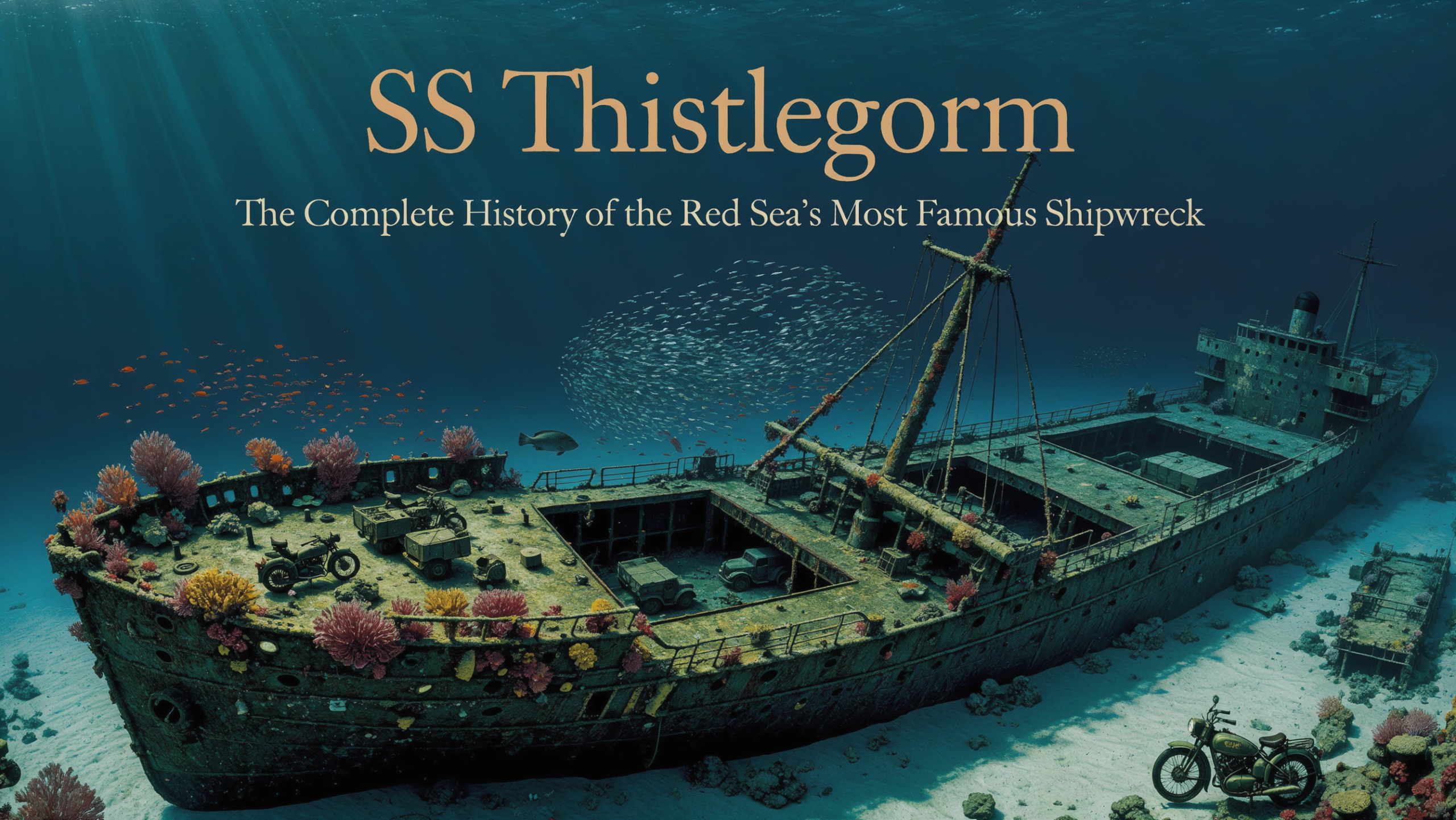
SS Thistlegorm: The Complete History of the Red Sea’s Most Famous Shipwreck
A British merchant ship built in Sunderland, armed for war, sunk by German bombers in the Red Sea and rediscovered by Jacques Cousteau — this is the true story behind one of the greatest wreck dives on Earth.
Short answer: The SS Thistlegorm was a British armed merchant steamship launched in 1940 and sunk by two German Heinkel He 111 bombers at about 01:30 on 6 October 1941 while anchored in the northern Red Sea, loaded with war supplies for the British forces in Egypt. Today she rests on the seabed in the Strait of Gubal and is considered one of the best wreck dives in the world.
Built
1940, Sunderland
Sunk
6 October 1941
Lives Lost
9 men
Rediscovered
Cousteau, early 1950s
In This Guide
- Built in Sunderland: The Birth of the Thistlegorm
- Why Britain Needed Ships Like Her
- An Armed Merchant Ship
- Her Voyages and the Final Journey
- The Cargo: A War in a Ship
- Waiting at Safe Anchorage F
- The Night of the Attack
- Forgotten Wreck, Cousteau and Rediscovery
- What Divers See Today
- Diving the Thistlegorm Responsibly
- Timeline at a Glance
- Frequently Asked Questions
Some shipwrecks are remembered because of a famous disaster. Others are remembered because of what they carried. The SS Thistlegorm is remembered for both. Resting on the seabed of the northern Red Sea, this British merchant steamship still holds the trucks, motorcycles, rifles, boots and railway locomotives that were meant for the Allied war effort in Egypt. Divers who descend onto her decks do not simply see a wreck — they see a cargo manifest from 1941 frozen in the water.
Her story is also a human one. The Thistlegorm was crewed by merchant seamen and Royal Navy gunners who sailed thousands of miles through dangerous seas to keep an army supplied. Nine of them never went home. This guide walks through the real history of the ship, from the shipyard on the River Wear to the bombing run over the Red Sea, and from Jacques Cousteau’s first dives to the diving boom that made her famous.
Built in Sunderland: The Birth of the Thistlegorm
The Thistlegorm was a product of one of Britain’s great shipbuilding regions. She was built in Sunderland, in the north-east of England, by the yard of Joseph L. Thompson & Sons, and launched in April 1940. The yard stood on the River Wear, an area that produced a huge number of merchant ships in the early twentieth century. Her owner was the Albyn Line, a Sunderland-based shipping company.
She was a classic British steam cargo ship of her time: a long, practical vessel designed to carry as much freight as possible rather than to impress anyone. Accounts describe her as roughly 126–128 metres long, driven by a triple-expansion steam engine rated at about 1,850 horsepower. Her cargo space was divided into several holds served by derricks, which made loading a wide range of goods — vehicles, crates, machinery — relatively straightforward.
What does “Thistlegorm” mean? The name is commonly explained as combining the thistle, the national emblem of Scotland, with gorm, a Gaelic word associated with the colour blue. The Albyn Line used names with Scottish flavour for its ships, and “Albyn” itself is an old poetic name for Scotland.
It is worth pausing on the timing. The ship entered the world just months into the Second World War. She never had a peacetime career. From the day she left the slipway, the Thistlegorm belonged to the war effort, and her entire working life lasted only about eighteen months.
Why Britain Needed Ships Like Her
To understand why a cargo ship was crossing the Red Sea in 1941, you have to look at the wider war. Britain was an island nation that depended on the sea for food, fuel and equipment, and the Merchant Navy was the lifeline that held everything together. Thousands of merchant ships sailed in convoys across the Atlantic and around the world, and thousands were lost to submarines, aircraft and mines.
Egypt: The Strategic Prize
Egypt mattered enormously. It was home to the Suez Canal, the shortcut linking Britain’s empire in the east with the Mediterranean, and it was the base from which British and Commonwealth forces defended the region. After Italy entered the war in June 1940, the Mediterranean became far more dangerous for ordinary shipping. Convoys carrying supplies to Egypt were therefore sent the long way round — around the Cape of Good Hope, up the coast of East Africa and into the Red Sea, entering the Suez area from the south.
The Desert War
On land, British and Commonwealth forces in the Western Desert had defeated Italian forces in a campaign known as Operation Compass in the winter of 1940–41. Then the situation changed: German troops under General Erwin Rommel arrived in North Africa in early 1941, and the fighting grew harder. The port of Tobruk was besieged from April 1941. The British formation in the desert, known as the Western Desert Force, was reorganised in September 1941 into the newly formed Eighth Army. The Thistlegorm’s cargo was intended for exactly these forces.
Supplying an army in the desert meant moving vehicles, spare parts, weapons and everyday equipment across half the planet. Every ship in that chain mattered. The Thistlegorm was a small piece of a very large logistical machine, and that is part of what makes her wreck so fascinating: she preserves the contents of that machine at a single moment in time.
An Armed Merchant Ship
Merchant ships in wartime were not defenceless. Under a British scheme known as DEMS — Defensively Equipped Merchant Ships — many vessels were fitted with guns and carried Royal Navy or army gunners alongside the merchant crew. The Thistlegorm received her defensive armament in 1941, shortly before her last voyage. Accounts describe a 120 mm (4.7-inch) anti-aircraft gun mounted at the stern and a heavy machine gun, with trained DEMS gunners to operate them.
The result was an unusual mixture of people on one ship. There were the merchant seamen — deck hands, engineers, firemen, cooks, officers — who ran the vessel day to day, and there were the naval gunners whose job was to defend it. Both groups shared the same risks. When the bombs fell in October 1941, the casualties included four sailors and five DEMS gunners.
Why this matters to divers: The big gun on the stern of the wreck is one of the most photographed features of the dive. It is a direct reminder that this was not just a cargo ship but a working part of the wartime defence system.
Her Voyages and the Final Journey
Between her launch and her loss, the Thistlegorm completed three voyages that took her across the Atlantic to destinations including the United States, Argentina and the West Indies. These were ordinary but vital cargo runs, the kind of work that thousands of merchant ships carried out under the constant threat of attack. Then, in 1941, came her fourth and final voyage.
She set sail from Glasgow on 2 June 1941, with Alexandria in Egypt as her destination. Her cargo was loaded at British ports before she joined the long convoy route south. Because the Mediterranean was too dangerous, she followed the Cape route: down the Atlantic, around the southern tip of Africa, then north through the Indian Ocean and up into the Red Sea. It was a journey of many weeks, with time spent in convoy and in port along the way.
At the head of the ship was her master, Captain William Ellis. As the vessel approached the Red Sea, the war in North Africa continued to make demands on every cargo that could be delivered. Nothing about her trip suggested that the journey would end anywhere other than in Egypt’s ports.
The Cargo: A War in a Ship
What makes the Thistlegorm so extraordinary is not only that she sank, but that so much of what she carried is still there. Most of the cargo stayed inside the ship, and divers today can look at it directly. The loading was a careful job: heavy equipment went into some holds, smaller items and ammunition into others, and large objects were lashed to the deck.
Vehicles
Rows of British military trucks, including Bedford and Morris Commercial lorries, along with Universal Carriers (often called Bren Gun Carriers), tracked vehicles used for moving troops and equipment.
Motorcycles
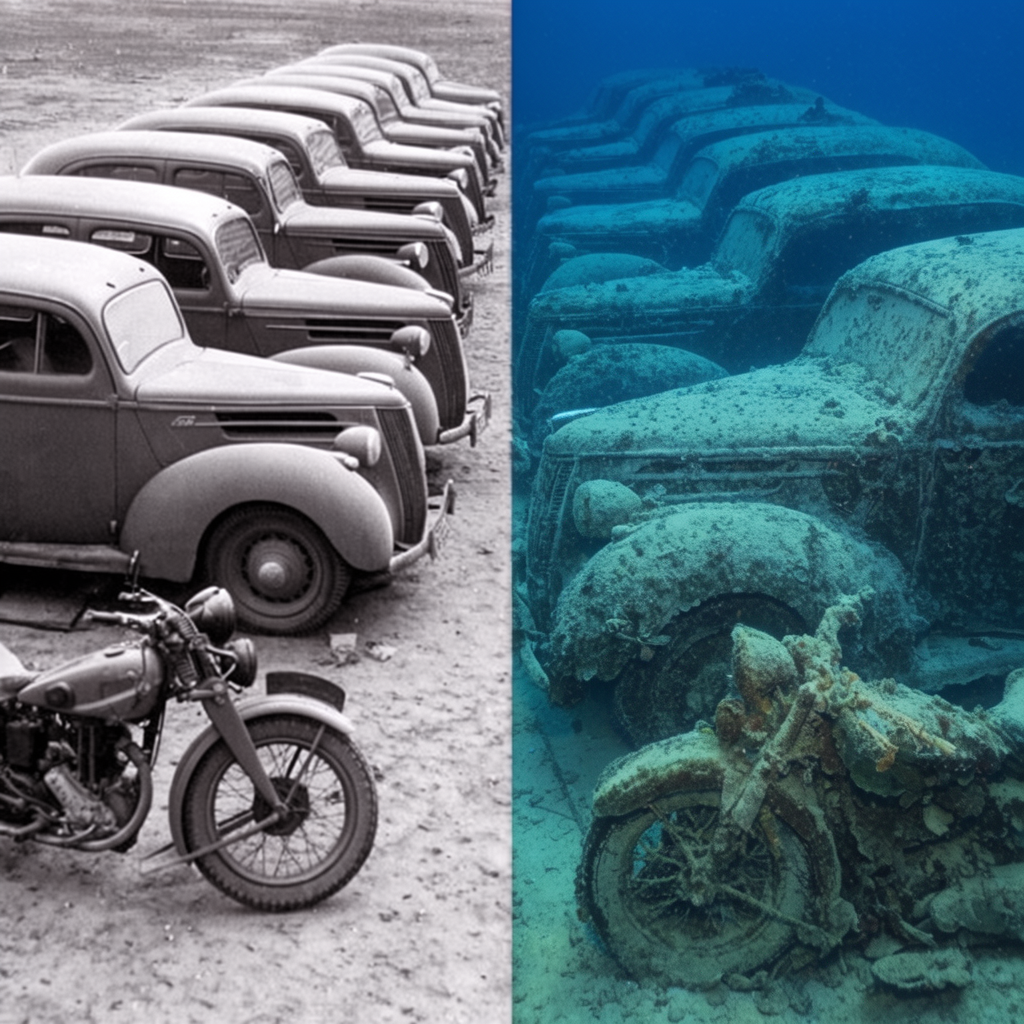
Dozens of British military motorcycles, among them BSA M20 and Norton models, still stacked in the holds in rows. They are among the most iconic images of the wreck.
Weapons & Ammunition
Rifles, other small arms, bombs and ammunition. The ammunition stored in Hold 4 played the decisive role in her destruction.
Everyday Supplies
Rubber Wellington boots, spare parts and general equipment — the unglamorous items that kept an army functioning.
Steam Locomotives
Steam locomotives, with their coal and water tenders, carried as deck cargo and intended for Egypt’s railways. The blast later threw them off the ship onto the seabed beside the wreck.
The locomotives deserve special mention. Egypt’s railways were an important part of the wider logistics of the war, and shipping steam engines as deck cargo shows how broad the supply effort was. They are not military equipment in the narrow sense, yet they were just as necessary. Today they lie on the sand next to the wreck, one of the most surprising sights in all of wreck diving.
The cargo also offers historians something rare. Normally, a ship’s contents are known only from paperwork. Here, the objects themselves survive. Vehicle types, markings, tools and packaging give a direct picture of the kit that British forces used in 1941. It is a time capsule in the most literal sense.
Waiting at Safe Anchorage F
After rounding Africa, the Thistlegorm entered the Red Sea and made her way north. Her intended path was through the Gulf of Suez and the Suez Canal into the Mediterranean, then on to Alexandria. But the canal route was blocked: a collision in the Suez Canal held up traffic, and the convoy could not pass through as planned.
Instead, ships were directed to wait at a designated holding area known as Safe Anchorage F. It lay in the Strait of Gubal, in the northern Red Sea, north of the headland of Ras Mohammed and close to the reef known as Shaab Ali. The Thistlegorm anchored there in September 1941 and stayed for a period of days while waiting for the route to clear.
The anchorage was considered far enough from the front line to be relatively safe, which explains the name. There were no escorts hovering over every ship, and no one expected a heavy attack. That sense of safety was about to be tested.
The Night of the Attack
In late 1941, the Allied build-up in Egypt had not gone unnoticed. German intelligence was aware that troops and equipment were gathering, and aircraft were sent to look for the shipping that supported them. On the night of 5–6 October 1941, two German Heinkel He 111 bombers took off to hunt for targets in the Red Sea region.
According to widely repeated accounts, the crews were searching for a large troop transport and failed to find it. Looking instead for any worthwhile target, they came upon the anchored ships at Safe Anchorage F. The Thistlegorm, as the largest vessel there, became the target.
Two Bombs on Hold 4
At about 01:30 the bombers attacked. Two bombs struck the ship, and both landed in Hold 4, near the stern. That hold contained ammunition. A fire started, spread rapidly, and the ammunition exploded. The blast was devastating: it tore the ship apart, and she sank in a V-shape as the two halves settled on the seabed. The heavy locomotives on deck were hurled clear of the ship by the force of the explosion.
Nine men lost their lives: four sailors and five DEMS gunners. The rest of the people on board survived and were taken off by Royal Navy vessels, with accounts naming the anti-aircraft cruiser HMS Carlisle among the rescue ships. Gallantry honours were later given to crew members for their conduct during the attack and its aftermath.
A place of remembrance. The Thistlegorm is a wonderful dive site, but it is also a war grave of sorts, because men died there. Reputable operators encourage divers to treat the wreck with respect: no touching, no souvenirs, and no disturbing the cargo.
Forgotten Wreck, Cousteau and Rediscovery
For roughly a decade, the Thistlegorm lay unseen. The war moved on; the Allied campaign in North Africa continued; and the wreck became a story known only to the people who worked the waters nearby.
Jacques Cousteau Finds Her
In the early 1950s, the famous French explorer Jacques-Yves Cousteau located the wreck, using information supplied by local fishermen who knew where the ship lay. Cousteau and his team, working from the research ship Calypso, dived on her and documented what they saw. Their discovery appeared in his writing and filmmaking about the Red Sea, including The Living Sea and The Silent World, and in a February 1956 article in National Geographic. Photographs from that period show details such as the ship’s bell still in place and divers exploring the structure.
Lost Again
Remarkably, after Cousteau’s visit the site faded from general knowledge again. It was remembered by local fishermen, but its exact position was not widely known to the diving world. Recreational diving was still in its infancy, and the Red Sea was far less developed than it is now.
The 1990s Diving Boom
The Thistlegorm returned to prominence in the 1990s, as Red Sea diving expanded rapidly and dive operators in the Sinai region began exploring wrecks and reefs systematically. Once the location was rediscovered by the diving community, word spread quickly. Divers had never seen a wreck quite like this: a large, largely intact World War II cargo ship still holding her load. Within a few years, she was one of the most talked-about dives anywhere.
What Divers See Today
The wreck rests on the sandy seabed at roughly 16 to 32 metres, depending on which part of the ship you are exploring. The bow and midships section sit upright, while the stern, broken away by the explosion, lies separated and rotated onto its side. The break between them exposes layers of cargo and decking, so a great deal can be seen without entering the ship.
Highlights of the Wreck
- The locomotives: Steam engines and tenders lying on the seabed beside the wreck, thrown there by the explosion.
- The stern gun: The anti-aircraft gun that tells the ship’s wartime story.
- The cargo holds: Trucks, motorcycles, carriers, rifles and boots arranged much as they were loaded.
- The bomb damage: The torn structure around Hold 4, where the ship was destroyed.
- The superstructure and bridge area: Details of the ship’s fittings, including rooms and equipment from the crew’s living and working spaces.
- Marine life: Over the decades the wreck has become an artificial reef, with schools of fish, coral growth and larger visitors around the steel.
Most divers plan at least two dives: one to see the exterior, the locomotives and the overall shape of the ship, and another to look more closely at the holds and cargo. Each dive reveals new details, which is why the Thistlegorm has such a loyal following among wreck enthusiasts.
Diving the Thistlegorm Responsibly
A wreck of this importance deserves careful treatment. Because the Thistlegorm is deep, subject to currents at times, and structurally complex, diving it safely depends on good planning, a qualified guide and the right level of experience.
Good Practice Checklist
- Check certification requirements: Operators usually expect an advanced-level certification or equivalent experience, plus recent logged dives. Always confirm with the dive centre.
- Choose a reputable operator: Good operators brief divers on conditions, use proper boat procedures and respect the site.
- Control your buoyancy: Fins and tanks can damage cargo and fragile structure, and sediment reduces visibility inside the holds.
- Leave everything where it is: Removing items is both unethical and illegal, and it steals the experience from future divers.
- Be careful inside: Penetrating the wreck is for experienced divers with proper training and guidance.
- Respect the memorial aspect: Nine men died here. Quiet curiosity is the right attitude.
Conservation
Heavy diving traffic puts pressure on a historic wreck. Anchoring, careless contact and souvenir hunting have damaged wrecks around the world. Organisations such as HEPCA and groups campaigning to protect the Thistlegorm work to promote mooring systems, education and responsible diving, and many dive operators now follow strict guidelines. Every diver who follows the rules helps to preserve the ship for the next generation.
Planning a Thistlegorm Trip from Hurghada
Many divers associate the Thistlegorm with the Sinai side of the Red Sea, but travellers staying in Hurghada also ask about the wreck, because Hurghada is a major diving centre with a strong dive-boat culture and easy access to other Red Sea sites. Whether a Thistlegorm trip is available, how it is organised, what certification is required and which dates are running all depend on the operators, the weather and sea conditions.
If you are not a certified diver, Hurghada has plenty of other ways to enjoy the Red Sea, from snorkelling and boat trips to island days and visits to the historic temples of Luxor. Our team at HurghadaToGo can help you understand your options and build a holiday that fits your interests.
Timeline at a Glance
April 1940
The Thistlegorm is launched by Joseph L. Thompson & Sons in Sunderland for the Albyn Line.
1940–1941
Three merchant voyages take her to the Americas and the West Indies.
Early 1941
She is fitted with an anti-aircraft gun and a heavy machine gun and prepared for service on the supply route to Egypt.
2 June 1941
She leaves Glasgow on her fourth voyage, bound for Alexandria via the Cape route.
September 1941
A collision in the Suez Canal holds up traffic, and she anchors at Safe Anchorage F in the Red Sea.
6 October 1941
At about 01:30, two German Heinkel He 111 bombers hit Hold 4. The ammunition explodes and the ship sinks; nine men are lost.
Early 1950s
Jacques Cousteau finds the wreck with help from local fishermen.
February 1956
National Geographic publishes images from Cousteau’s expedition.
1990s
The wreck becomes a world-famous dive site as Red Sea diving expands.
Frequently Asked Questions About the SS Thistlegorm
What was the SS Thistlegorm?
She was a British armed merchant steamship built in Sunderland in 1940. She was carrying supplies for British forces in Egypt when she was sunk by German aircraft in the Red Sea in October 1941.
When and how did the Thistlegorm sink?
She sank at about 01:30 on 6 October 1941, after two bombs from German Heinkel He 111 aircraft struck Hold 4, which contained ammunition. The resulting explosion broke the ship in two.
How many people died?
Nine men were killed: four sailors and five DEMS gunners. Everyone else on board survived and was rescued.
What was she carrying?
Military trucks, Universal Carriers, motorcycles, rifles, ammunition, Wellington boots and other supplies for the British forces in Egypt, plus steam locomotives and tenders carried on deck.
Why was she in the Red Sea?
Because the Mediterranean was dangerous, supplies for Egypt were sent around Africa and up the Red Sea. A collision in the Suez Canal delayed the convoy, so she waited at Safe Anchorage F.
Who discovered the wreck?
Jacques Cousteau located the wreck in the early 1950s using information from local fishermen. It became widely known to recreational divers in the 1990s.
How deep is the Thistlegorm?
Depending on the section of the wreck, she lies at roughly 16 to 32 metres. Exact depths vary by location on the ship, so ask your dive guide for the plan.
Why is it called the Thistlegorm?
The name is commonly explained as a combination of “thistle,” Scotland’s national emblem, and “gorm,” a Gaelic word associated with blue, in keeping with the Scottish themes used by her owner, the Albyn Line.
Do you need to be a certified diver to see it?
Yes. The Thistlegorm is a scuba dive, and operators generally expect an advanced-level certification or equivalent experience. Non-divers can enjoy other Red Sea activities instead.
Can I take anything from the wreck?
No. Removing items is prohibited and harmful. The cargo and the ship are part of a shared historical record and a place where men lost their lives.
Can I join a Thistlegorm trip from Hurghada?
Availability depends on operators, weather and certification. Contact our team and we will help you understand current options.
Why the Thistlegorm Still Matters
The SS Thistlegorm is more than a spectacular dive. She is a record of how the Second World War was fought and supplied, a memorial to the men who died aboard her, and a story of rediscovery that links Cousteau’s pioneering days with modern recreational diving. The ship was in service for barely a year and a half, yet she has fascinated people for more than eighty years.
Whether you are a diver planning a trip, a history lover who wants to understand the wreck, or a traveller curious about the Red Sea, the Thistlegorm rewards attention. Learn her story, treat her with respect, and she will keep telling it for generations to come.
Plan Your Red Sea Adventure with HurghadaToGo
Ask us about Red Sea diving, snorkelling, island trips and day excursions from Hurghada. Tell us your dates and interests, and we will help you choose.
WhatsApp +201009255585 [email protected]
Explore more at Hurghada Excursion and HurghadaToGo
Historical references
Background drawn from publicly available histories of the ship, including the SS Thistlegorm article on Wikipedia, the wreck history pages of The Thistlegorm Project, and the PADI Blog.